1. Cooking with salt ( Sodium )
Salt is undoubtedly the most important ingredient in food preparation. It acts as a flavor enhancer and gives dishes character.
Manufacturers often add large amounts of refined table salt to processed products, causing us to unwittingly ingest far too much salt.
Average intake: men 10 g/day, women 7.5 g/day
Recommended maximum: 6 g of salt (2.4 g of sodium) per day
Minimum requirement: 1-3 g of salt (0.4-1.2 g of sodium) per day
⚠️ Too much table salt can lead to high blood pressure and additional strain on the kidneys, while too little salt can also cause problems for fluid balance and nerve conduction.
2. Types of salt and their properties.
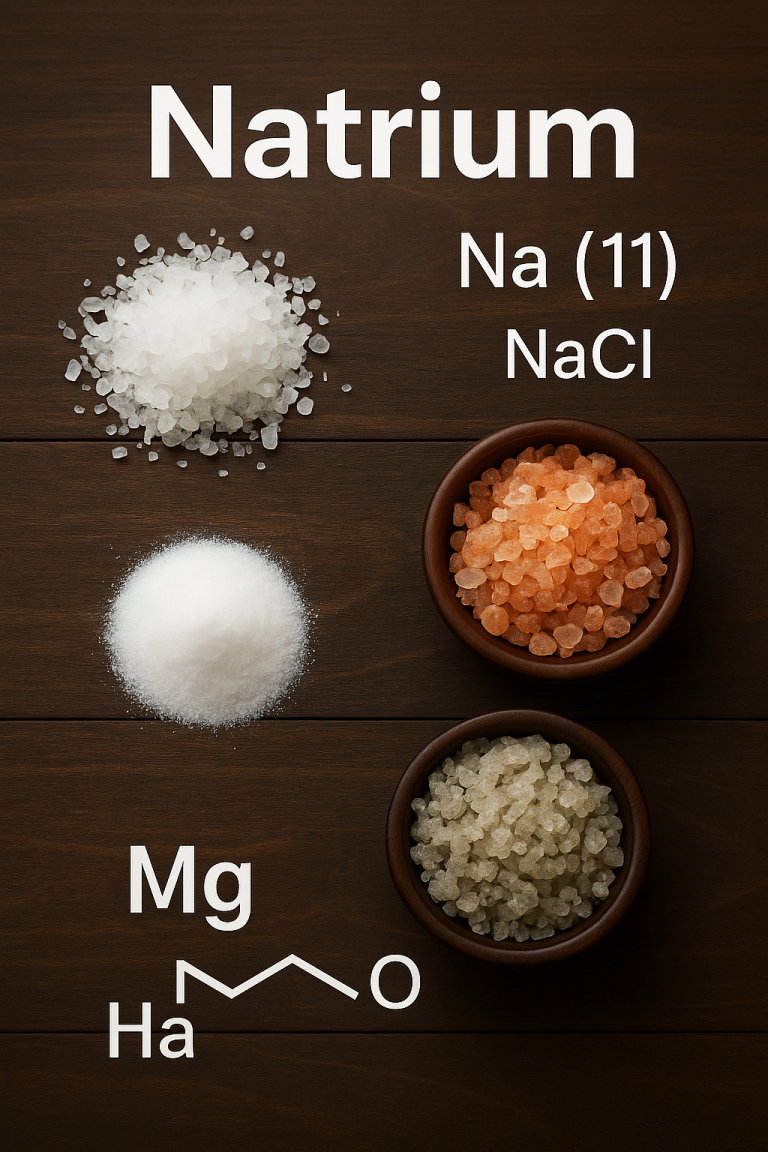
Not every salt is the same. Below are the most commonly used types and their sodium content:
- Table salt: 39.1% sodium - heavily refined, contains anti-caking agents with toxins (including aluminum ☠️).
- Sea salt: 38.3% sodium - contains small amounts of potassium, iron and zinc. White supermarket varieties are often bleached → less pure.
- Himalayan salt: 36.8% sodium - pink color due to iron oxide. Contains minerals such as potassium, calcium, magnesium and iron.
- Celtic sea salt: 33.8% sodium - rich in more than 70 minerals, lowers blood pressure through magnesium and potassium.
📄 Analysis: https://www.ahealthylife.nl/wp-content/uploads/2015/10/Keltisch-zeezout-Analyse.pdf
3. Table salt
Table salt for 97% consists of sodium chloride and contains anti-caking agents with aluminum - toxic to the body ☠️. It is highly refined and almost all minerals have been removed. Iodine is often added, but this does not make the product healthier. Therefore, daily use is not recommended.
4. Himalayan salt
Himalayan salt comes from mines in Pakistan and owes its pink color to iron oxide. It contains minerals such as potassium, calcium, magnesium and iron. Its sodium content is lower than table salt, making it considered a more natural and milder alternative.
5. Sea salt
Sea salt is extracted by evaporation of seawater. It is chemically very similar to table salt, but sometimes contains traces of potassium, iron and zinc.
- Darker sea salt = more minerals
-White supermarket sea salt = often artificially bleached with chemicals (such as chlorine or lye compounds) → therefore less pure and with loss of valuable minerals
- May contain slight traces of heavy metals (due to polluted seas)
6. Celtic sea salt
Celtic sea salt comes from salt marshes in France and is considered the healthiest type of salt.
- Low sodium content (33.8%)
- Rich in magnesium and potassium → blood pressure lowering
- Contains more than 70 minerals
- Light gray, damp texture
- No chemical processing
7. Sole
A sole is a solution of 1/3 salt and 2/3 water. Often a teaspoon is added to a glass of water in the morning or evening.
Sole can help restore minerals and electrolytes, for example:
- After sports
- After sauna
- When sweating
- After illness or drinking a lot of water
👉 Best choice: Celtic sea salt for sole.
⚠️ Using too much or too often can still lead to excess sodium.
8. High blood pressure
Too much table salt can lead to high blood pressure. But high blood pressure is also affected by:
- Not enough exercise
- Stress
- Overweight
- Not enough fruits & vegetables (potassium deficiency)
9. The true problem
The real problem: processed products with refined table salt, such as:
- Bread
- Soup
- Pizza
- Snacks
- Junk food
This salt consists almost exclusively of sodium chloride and lacks the 84 other minerals that are present in unprocessed salt.
⚠️ avoid refined table salt!!! ☠️
10. Sodium: mass murderer or misunderstanding?
Although lower salt intake can lower blood pressure, it has not been proven that less sodium automatically prevents cardiovascular disease.
Many studies have been conducted with refined table salt and thus say little about natural salts such as Celtic or Himalayan salt.
11. Spiritual meaning of salt ✨
Salt is regarded worldwide as a powerful tool for purification and protection.
- Purification: salt baths, salt lamps, salt circles.
- Protection: salt around houses or spaces as a barrier against negative energy.
- Grounding: helps release emotions and find peace.
🌿 Celtic sea salt is often spiritually regarded as the most “living salt” due to its natural, unprocessed nature and many minerals.

 English
  Dutch
Dutch